1

Core Advantages

In-depth analysis of the essential kinetic changes during protein activation, providing critical physicochemical kinetic information on protein function. This includes intermediate states, transition states, their connecting structural conformations, and the full free energy landscape, with particular emphasis on activation energy barrier data.
By elevating structural information to a higher dimension—capturing the entire protein activation process rather than static stable states—our database overcomes the fundamental limitations of conventional protein databases and significantly enhances data quality for the CADD and AIDD industries.
The database unlocks a new dimension in target information, enabling mechanistic studies of protein function, identification of novel binding pockets, structure-based design for challenging targets, biased molecular design, mutational effect prediction, and retrospective analysis of existing drugs.

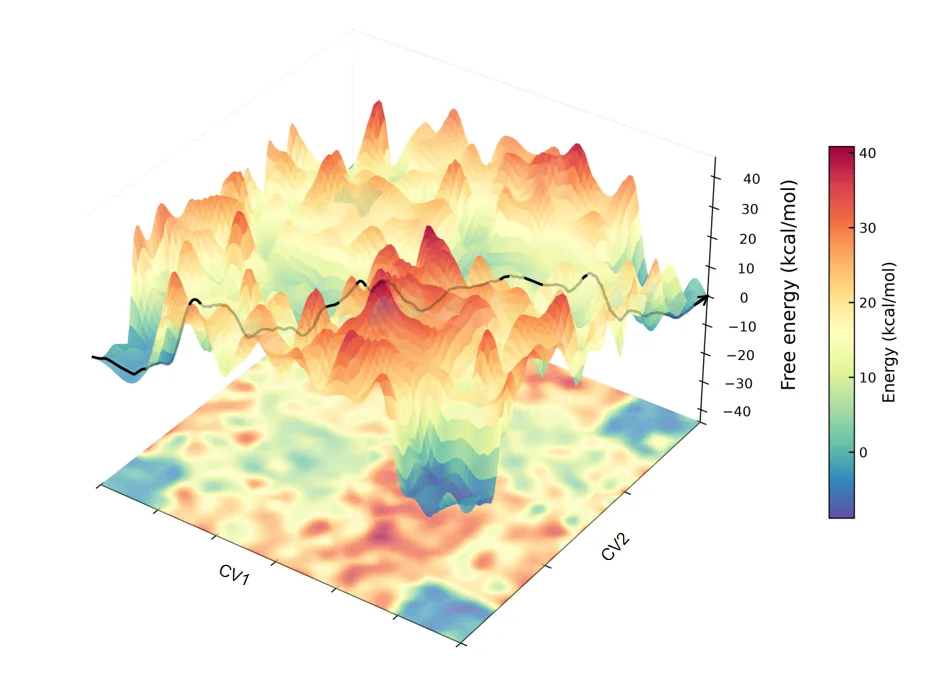
Protein Function and Multidimensional Free Energy Landscape

The majority of functional proteins exist primarily in the stable inactive state (IAS), yet their function is ultimately determined by the transition from IAS to the active state (AS). As depicted in the upper panel black line, it progresses through multiple stages, along with significant conformational rearrangements.

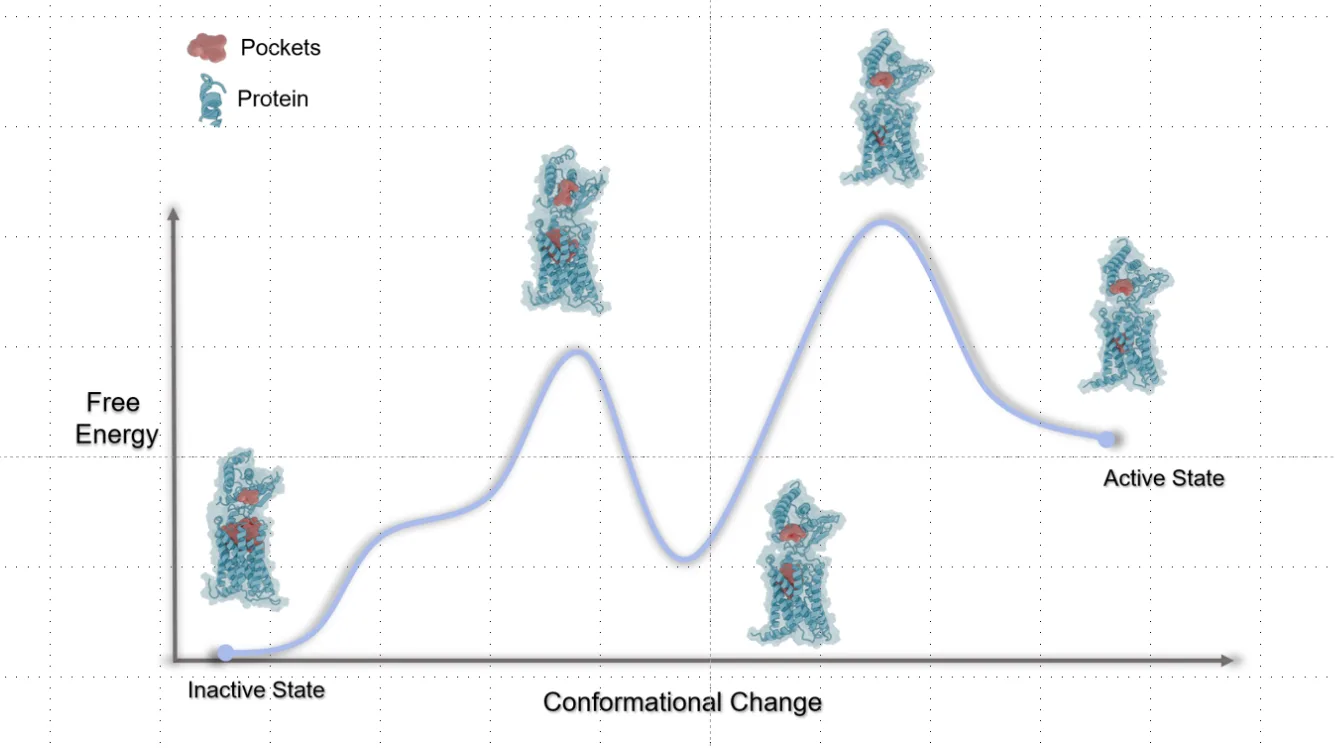
1D Free Energy Profile

Example of a one-dimensional free energy profile of the full protein activation process, simplified from the left panel. As protein activation proceeds, the free energy, conformation, and molecular pockets all undergo concurrent changes. Elucidating this transition pathway is essential for understanding protein regulatory mechanisms and for rational drug design.

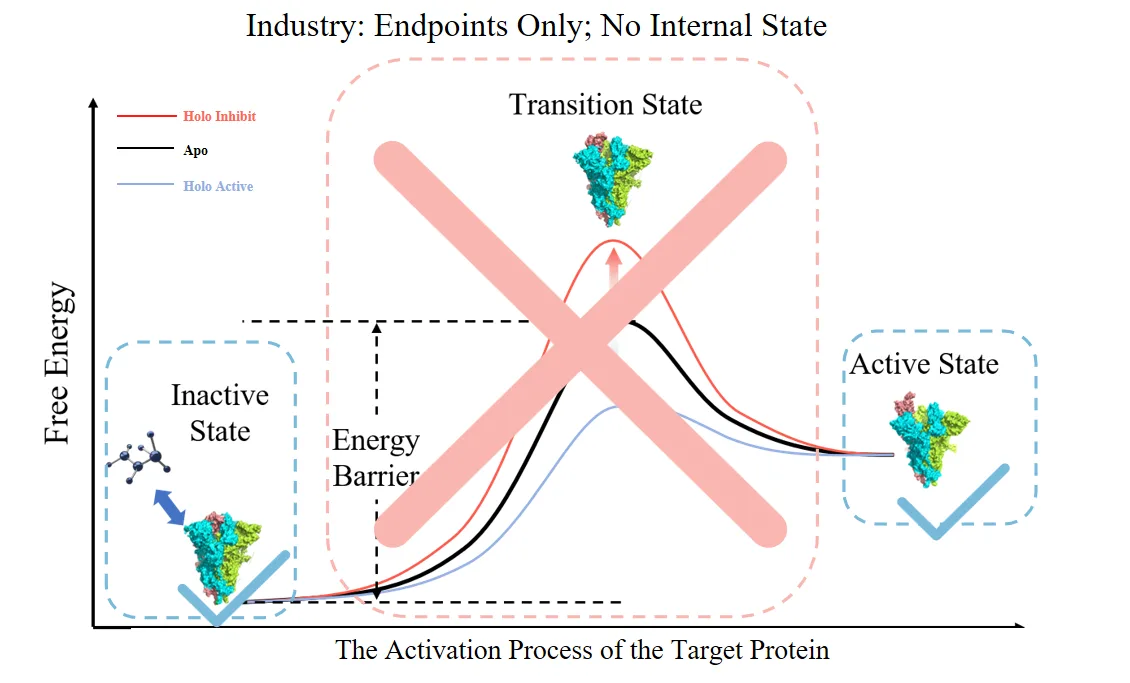
Target protein information used in industry now

Traditional protein databases (e.g., the PDB) offer only structural data for proteins in the stable inactive states (IAS) and sometimes the active states (AS). However, the intermediate states, the transition state, and the connection between inactive and active conformations remain unattainable due to the constraints of existing experimental approaches.

Free energy information

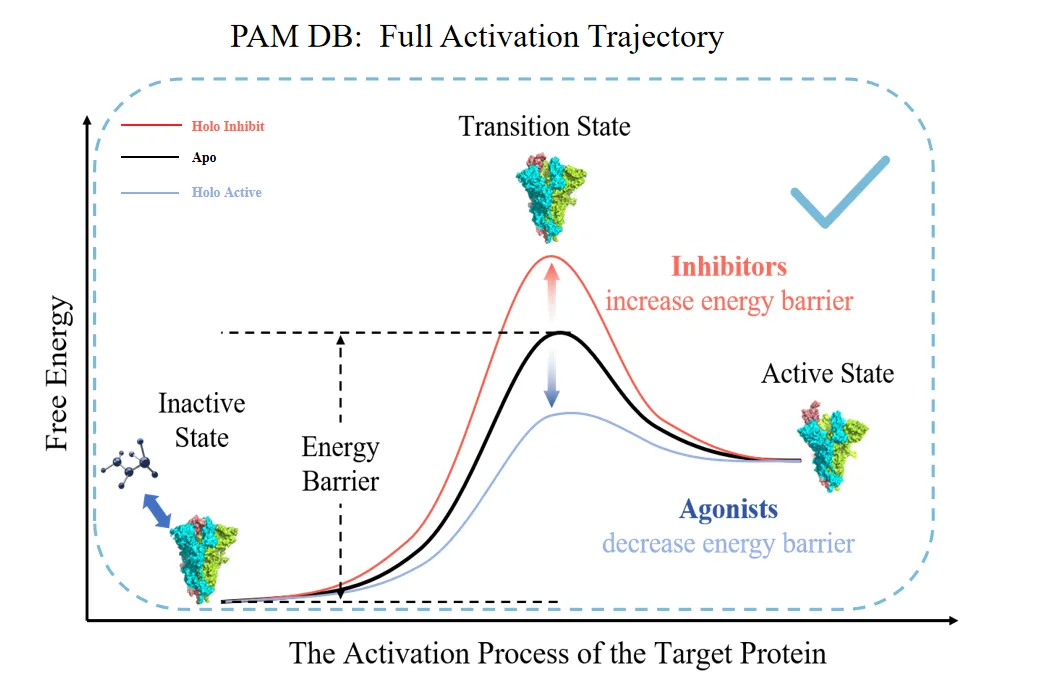
Exclusive Protein Mechanism Information from Momed

Momed's PAM-DB captures the complete transition process of proteins from the inactive state (IAS) to the active state (AS), utilizing cutting-edge computational biology methods and reverse validation via wet-lab experiments. This includes intermediate transition states with lifetimes as short as femtoseconds. The full activation process encompasses both structural changes and the associated energetic profiles.

Target protein information used in industry now

Traditional protein structural and dynamic data come from molecular dynamics (MD) simulations of inactive or metastable active states, where the overall conformation is relatively stable. As a result, pocket conformations are largely static. Occasional fluctuations near the energy basin may be observed, but these data only indicate binding affinity to the inactive or certain active states—they cannot predict how a molecule binding in the pocket affects activation, particularly the activation barrier. Drug design from such incomplete data is like a blind box.

Structural animation diagram

Exclusive Protein Mechanism Information from Momed

Momed PAM-DB captures the complete transition of the protein from its inactive state (IAS) through intermediate states and transition states to the active state (AS). Unlike conventional MD simulations based on the IAS, the global protein conformation undergoes substantial changes during activation. As shown in this animation, one can observe the opening of the GPCR receptor pocket, the insertion of the G protein helix, and the large-scale conformational rearrangement of the G protein domains — among other events. The red regions highlight the changes in the binding pocket.

Cutting-edge —— featuring forward-looking computational biology algorithms and reverse validation via wet‑lab experiments.

References

1.Bai C, Warshel A. Nat Chem. 2020;12:1187.

2.Bai C, Warshel A. J Am Chem Soc. 2021;143:17646.

3.He Y, Bai C. Angew Chem Int Ed Engl. 2024;63:e202405765.

4.Yan J, Warshel A, Bai C. J Am Chem Soc. 2024;146:26297.

5.Zhang Y, Warshel A, Bai C. J Am Chem Soc. 2025;147:3539.

6.Bai C, Chen G, Warshel A. J Am Chem Soc. 2021;143:17646.

7.Zhang Y, Warshel A, Bai C. J Am Chem Soc. 2024;146:4665.

8.Bai C, Warshel A. Proc Natl Acad Sci USA. 2019;116:19484.

9.Liu S, Chen H, Bai C, Tian C. Sci Adv. 2025;11:eadx4432.

10.Zhu X, Warshel A, Bai C. Proc Natl Acad Sci USA. 2024;121:e2401079121.

2

Use value

Our database fully captures the structural changes of proteins during target activation, including alterations in binding pockets, the formation of new pockets, and the disappearance of old ones—not merely the morphological changes of existing pockets. Moreover, we go beyond steady-state binding energies (inactive state or partially stable active state) to provide other critical kinetic information, such as activation energy barriers and transition states.

Leveraging this new dimension of protein mechanism data, our platform assists medicinal chemists in understanding protein function, and in building and training novel CADD standards and AIDD models, offering clear mechanistic clues and constraints for molecular screening and design. It also enables retrospective mechanistic analysis of existing molecules, providing a reference for future molecular design.

This new-dimensional data on protein mechanisms proves valuable for drug design targeting challenging targets and for biased molecular design. Furthermore, the database can be applied to predict mutational effects, off-target effects, drug resistance, and more.

3

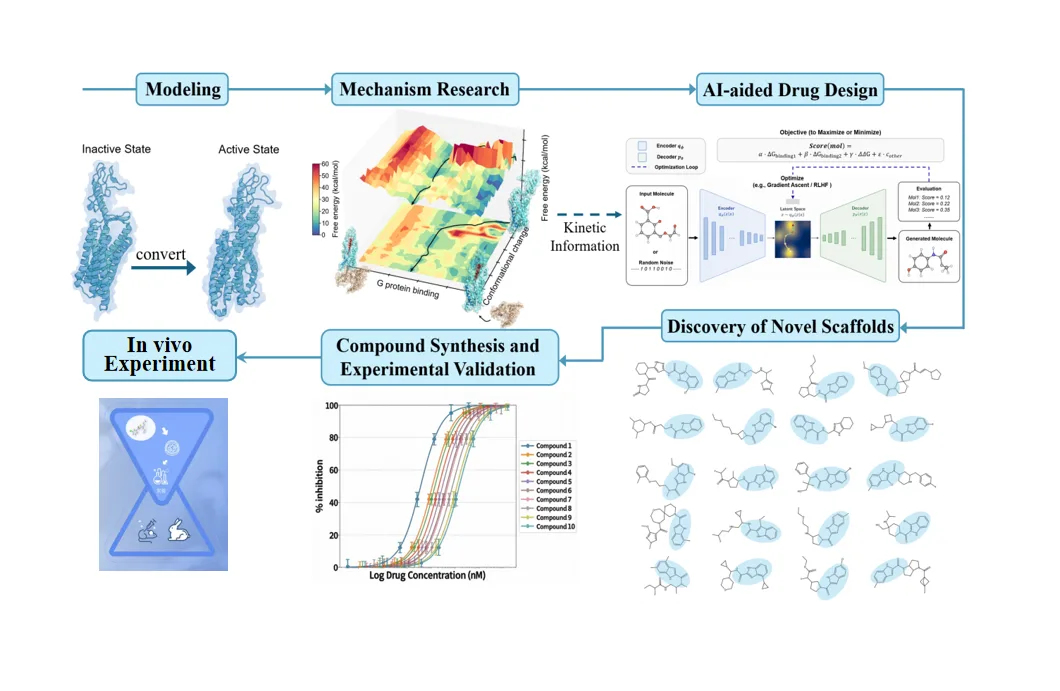
Usage examples: Using our protein mechanism analysis platform, we have achieved results.

3.1 GCGR Biased Inhibitor Molecules with Novel Skeleton Structures

Momed has conducted in-depth mechanistic studies on the GCGR protein and achieved a breakthrough in overcoming the bottlenecks associated with GCGR inhibitor design. By employing novel molecular scaffolds, we have attained precise conformational regulation of GCGR. Our lead compound exhibits superior biased inhibition, with an 8-fold increase in cAMP biased inhibitory activity relative to the only clinical-stage benchmark, LGD-6972. This process took only three months to synthesize fewer than 50 molecules.

3.2 ER Inhibitors Based on New PROTAC Scaffolds

We performed a detailed analysis of the working mechanism of the ER protein. Using the MechGen™ PROTAC molecule generation module, we designed multiple PROTAC molecules with novel proprietary scaffolds. Through precise molecular structure optimization, the core compounds exhibited picomolar (pM) degradation activity across various cell lines, including MCF-7, while also demonstrating excellent pharmacokinetic properties. This process took only three months to synthesize fewer than 100 molecules.

3.3 Molecular Design of Next-Generation DPP-1 Inhibitors

We resolved DPP-1´s full inactive-to-active transition, identified key barriers and transition-state conformations, and confirmed marketed/Phase III inhibitors act by raising these barriers. Residue energy decomposition pinpointed key residues, translated into explicit interaction constraints. MechGen™-guided pharmacophore engineering at these sites enabled precise lead optimization. The resulting compounds show excellent enzymatic and cellular potency, good metabolic stability, and best-in-class permeability—all achieved in two months with <30 molecules synthesized.

4

Data types and purchase modes

4.1 Data type

Basic Version

This version contains only raw data from unprocessed structural transformations, including a large number of non-physical atomic distances. It is intended for users with advanced expertise in handling high-energy, non-steady-state proteins, structural pruning, and modeling—and who are passionate about tackling challenging problems.

Standard Version

This version includes all content from the Basic Version. In addition, we have pre-processed the key structures along the activation pathway. The provided all-atom structures and conformational energy trends can be directly applied to innovative drug discovery workflows such as docking and screening. Furthermore, this version contains docking calculation demo files targeting high-energy, non-steady-state structures. Our technical team also offers basic consultation and advice for any issues encountered during database usage.

Premium Version

This version encompasses all content from the Standard Version. Additionally, it grants priority rights for customized pipeline collaborations under equivalent terms, as well as priority rights for target exclusivity services. Premium users are entitled to be notified of database update strategies, with their target requirements given priority consideration. Extensive technical support from our team is also provided.

4.2 Purchasing Modes

Purchase Mode-A: By Protein

This mode operates under an order contract system, with encrypted fingerprint data delivered.

Notes:

This mode involves the purchase of existing protein data from the database. Bulk purchases are eligible for special discounted pricing.

Purchase Mode-B: Subscription

This mode operates under an order contract system, with encrypted fingerprint data delivered.

Explanation:

  • The database is continuously updated. Subscribers will receive new protein data throughout the subscription period. As a complimentary bonus, every one-year subscription includes 5 randomly selected protein entries from the database.


  • We guarantee updates every six months, with at least 5 protein datasets released per update. The planned release list is announced 3 months in advance.


  • Subscribers may suggest protein targets 4 months prior to a data release, though specific proteins cannot be guaranteed.


Subscription content

|Subscription period
|Number of updates
|Number of new targets added
|Gift targets, your choice
Subscribe for 1 year
≥ 2
≥ 10
5
Subscribed for 2 years
≥ 4
≥ 20
10

Purchase Mode-C: Customized purchase

We welcome customized or exclusive order.

If there are specific proteins or exclusive requirements, an exclusive cooperation model can be discussed based on actual circumstances.

5

Contact Us

Consultation and ordering

For consultation and orders, please specify:

· (commercial / non-commercial)

● User institution scope

● Data package

· (Basic / Standard / Premium)

● Purchase mode

· (by protein / subscription / customized)

Send the details to the email below, or fill out the online form for a quote.

𝐄-𝐦𝐚𝐢𝐥: pamdb@momedtech.com.cn